|
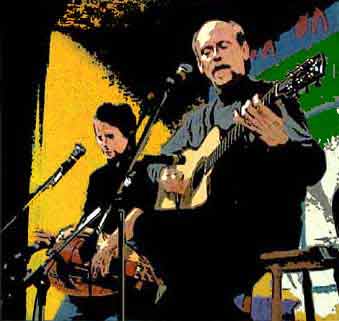
Pint and Dale sing rousing songs of
the sea
“William Pint and Felicia Dale
have traveled the world playing maritime music and finding new
songs about the role of the sea in people’s lives.
They’ll bring their music to Olympia’s
Oldtime Medicine show at 8 p.m. Saturday.
But if you expect a quiet folklorist
presentation, you’d be far wrong. Pint’s driving guitar
and mandola and Dale’s soaring hurdy-gurdy produce a ringing
folk-rock sound that energizes the singers’ close harmonies.
"Dale first
heard a
hurdy-gurdy
in the
late
’80s on a
Seattle street,
and knew she
had to have
one. The
hurdy-gurdy
dates from the
11th century
and was used
mostly for
court dances,
but Dale’s use
of the ancient
stringed
instrument
strikes a
balance
between old
and new." |
“People often say we sound like
four people,” Pint
said in a telephone interview from their
home in Seattle. “Maybe it’s because we play loud.
With a wailing hurdy-gurdy and guitar and two voices on top,
we make a lot of noise.”
For the last few Decembers, the Seattle
duo has performed in Magical Strings’ Yuletide Concerts,
so they are not strangers to acoustic music fans in Olympia.
Dale first heard a hurdy-gurdy in the
late ’80s on a Seattle street, and knew she had to have
one. The hurdy-gurdy dates from the 11th century and was used
mostly for court dances, but Dale’s use of the ancient stringed
instrument strikes a balance between old and new.
“We’re very fortunate that
we ended up with an instrument that really goes well with our
voices and William’s guitars,” she said. “It’s
a wonderful sound, and I love playing it. It can sound like a
violin or bagpipes or a synthesizer, just a tremendous range
of expression.”
Or even, an electric guitar.
“Felicia uses it in atypical ways;
the majority of players today use it to play basically French
dance tunes, a narrow band of music,” Pint said. “She
uses it in creative ways. It can be a background instrument,
but it can take the place of an electric guitar as well.”
Nowhere is that more apparent that on
up-tempo numbers such as “John Riley” and “Round
the Corner Sally” on their 1997 release of the same title.
“I like the aggressiveness of it,” Dale said.
Pint grew up in Milwaukee and performed
in folk groups in the ’70s and ’80s, before moving
to the Northwest in the late ’80s. He met Dale in Tacoma
when a mutual friend introduced them at an open-mike session
at Victory Music.
Dale is a Washington native who grew
up on Vashon Island. With a father who was a sea captain, sailing
and songs of the sea were a natural part of her childhood.
She described her life’s
progressions: “I took the requisite piano lessons when I
was a kid and turned into a teen-ager full of angst and a guitar
and gave it all up for horses, and then gave up horses for motorcycles
and then met William. Now I’m back to horses and music.
I have no idea how it all happened.”
For Pint, the interest in maritime music
evolved over time.
“It was the Irish music connection,
which I had been involved in before, that got me involved in
maritime music,” he explained. “A lot of the body of
sea chanteys come from the Irish tradition. We felt like missionaries
at times with this music in the ’70s; people would either
wonder why we bothered to play it at all, or want to know where
it came from.”
Of course this was all before The Chieftains
became international superstars and Riverdance step-danced its
way across the television screens.
Recently Dale branched out from music
into writing, having her first young adult story, called “The
Sword of Undeath” published in the anthology “Warrior
Princesses.”
“I had always enjoyed writing as
a child,” she said, “and now I’m thrilled to be
published.”
Today Pint and Dale tour Europe and
various parts of the United States for about five months each
year.
“A lot of our music is derived
from Europe and the British isles, so it’s fun to put an
American twist on it and go over and play it for those audiences,”
Pint said.
“I love it in England and Holland;
there’s such a desire there to participate and keep this
art form of singing alive that I just feel part of something
incredibly important,” Dale added.
Not that there isn’t interest here. Pint and Dale keep busy the other seven
months of the year performing at festivals and local clubs in
the Northwest.
It makes for a good life. “This music allows us to go to
other countries and meet incredibly nice people, and here as
well certainly, and not work the way most of the world has to,”
Dale said.
“We spend a fair amount of time
working on the computer doing research and practicing. But mostly
it’s an easygoing life; we don’t have a lot of money
but we’re really happy.””
Bill Compton is a free-lance
writer who pursues the musical muse from the suburbs of Lacey.
Bill Compton
The Olympian
Friday, January 15, 1999 |